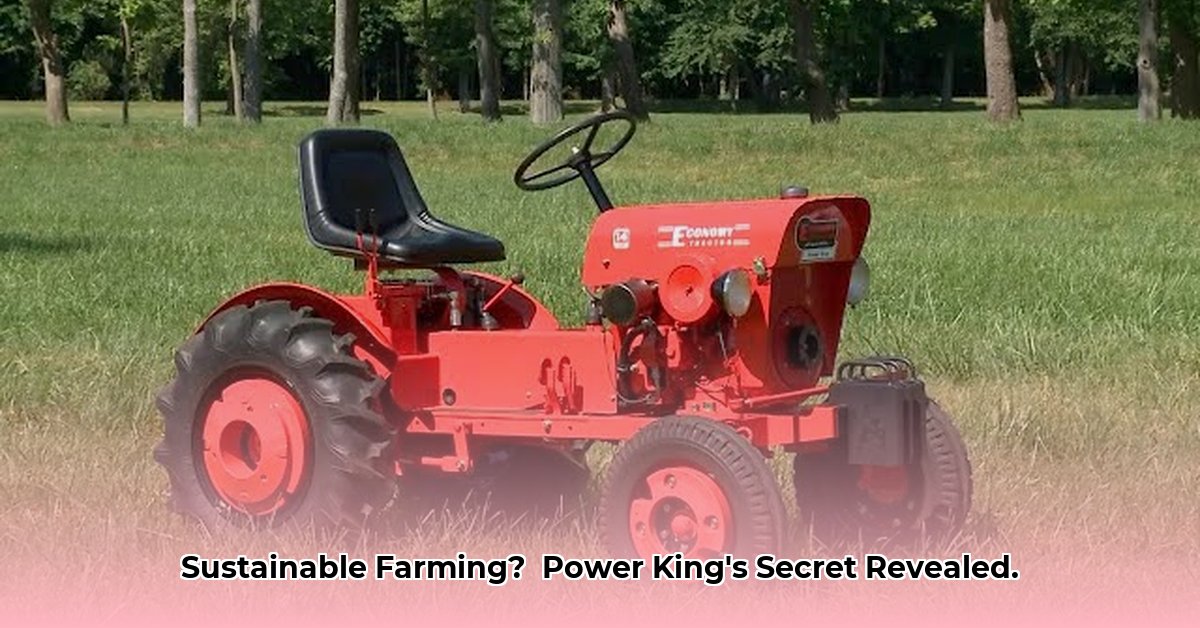
Let's be real: small-scale farming can be challenging, especially when it comes to finding reliable, affordable equipment. But there's a hidden gem from the past that's surprisingly well-suited for modern, sustainable farming: the Power King Economy (EPK) tractor. These aren't high-tech behemoths; they're sturdy, versatile workhorses perfect for smaller plots. For more information on EPK tractors, check out this helpful resource: Power King Info.
Getting to Know Your Power King Economy Tractor
Manufactured by the Engineered Products Company (EPCO) between 1946 and 1996, EPK tractors weren't designed for massive farms. Their strength lies in their compact size and adaptability. Many models featured a 14-horsepower Kohler engine and a range of attachments—tillers, mowers, even snowplows—making them perfect for diverse tasks on smaller farms and homesteads.
However, finding parts can be a challenge. Model identification wasn't always consistent, so pinpointing your exact model is crucial for sourcing parts. Online communities and forums are invaluable resources for this, offering guidance from fellow EPK owners. "These online groups are like treasure troves of information," says John Miller, a veteran small-scale farmer and EPK enthusiast.
Preparing Your Power King for Action: A Step-by-Step Guide
Before you start tilling, thorough preparation is key. Think of it as getting your trusty pickup truck ready for a long journey.
Identify Your Tractor's Model: Find the serial number and use online resources (like the Yesterday's Tractors forum) to identify your specific model. This is crucial for efficient part sourcing.
Conduct a Thorough Inspection: Perform a complete visual inspection, noting any damage or needed repairs. Pay close attention to the engine, transmission, hydraulics, and anything that could cause issues. Document everything that needs attention.
Source Necessary Parts: Online marketplaces (eBay, etc.), forums, local salvage yards, and even other EPK owners can be your sources. Sometimes, parts from similar models can work.
Perform Routine Maintenance: This extends your tractor's life. Change fluids regularly (engine oil, transmission oil, hydraulic oil), check belts and hoses, and lubricate moving parts. A well-maintained tractor works better and lasts longer.
Test Run Before Serious Work: Before tackling major tasks, test the tractor in a safe area to identify minor problems before they become major ones.
Tasks Perfect for Your EPK Tractor
Despite their age, EPK tractors are surprisingly versatile:
- Tilling Small Plots: Their compact size is ideal for small gardens or fields.
- Mowing: Many models had various mower decks, simplifying lawn maintenance and hay cutting.
- Light Hauling: Attach a small trailer for transporting materials.
- Snow Removal (Some Models): A surprising bonus!
Potential Challenges and Solutions
EPK tractors are vintage; challenges are inevitable. Preparation and planning are key:
| Challenge | Solutions |
|---|---|
| Part Availability | Online communities, salvage yards, 3D-printed parts. |
| Older Engine Technology | Regular maintenance; explore biofuel conversion (requires research). |
| Model Identification | Online forums and resources are essential; persistence is key. |
| Repair Knowledge | Online resources, manuals, and local mechanics. |
Investing in Long-Term Sustainability with Your EPK
Owning an EPK isn't just about the purchase; it's about building a long-term relationship with your equipment. This means proactive maintenance, networking for parts and information, and exploring innovative solutions like 3D-printed parts. With proper care, your EPK can be a key part of your sustainable and efficient farm for years.
How to Source Parts for Your Vintage EPK
Finding parts can feel like a quest. Original parts are rare. This section guides you through the process.
- Online Marketplaces: eBay and similar sites; be patient.
- Vintage Tractor Forums: Engage with online communities for tips and parts.
- Specialized Dealers: Some dealers specialize in parts for older tractors.
- Local Machine Shops: They can create custom parts.
- Salvage Yards: A last resort, but sometimes yield treasures.
Modernizing Your Vintage Workhorse (Optional)
Consider upgrades like adding a three-point hitch (requires careful planning and potentially custom fabrication) or hydraulics (complex and may require professional assistance). Always prioritize safety.
Cost vs. Benefit: The Economic Equation
Calculate the total cost of restoration (parts, labor, modifications) and compare it to the cost of a newer machine. Consider fuel efficiency, lifespan, and environmental impact.
Sustainable Practices: Beyond the Tractor
Sustainable farming extends beyond the tractor itself. Use environmentally friendly materials during restoration, minimize waste, and adopt energy-efficient practices. Your goal is a resilient farm, not just a restored machine. "Sustainable farming is about long-term viability," says Dr. Emily Carter, Agricultural Engineering Department, University of California, Davis. "Using equipment like the EPK, with due diligence in maintenance and repairs, absolutely fits that model."